Showing posts with label video games. Show all posts

Thursday, December 1, 2011

It's like some kind of comedy routine...


Fate/Extra (PSP)
Released November 1, 2011 (US); July 22, 2010 (JP). Developed by Type-Moon/Image Epoch; published by Axsys/Marvelous Entertainment
Genre: JRPG

The most recent (in the US) entry in the expansive and pretty insane Fate/stay night saga, Fate/Extra is a weird, but relatively cool, JRPG that finally got a release in the states about a year and a half after its Japanese release. I got very heavily into F/sn thanks to some of my friends; I do mean these thanks in a genuine way, because it has been rewarding, even if it has had as many "Are you kidding me?" moments as many other series, like Parasite Eve or Persona (the series I find it resembles most closely). So perhaps it would be a good idea to get into the framing devices, the storylines, etc.; be warned that there will be some spoilers ahead for the entire series.

So, basically, there's this thing called the Holy Grail. When you think of that, you probably think of the golden cup similar to that seen in the Monty Python film, or perhaps the Holy Chalice.In this case, as I'm led to understand, it's something more intangible. Wars are fought over it, but not in the traditional "millions get in their sunday best and grab rifles and blast each other's heads off" -- no. It's more like a tournament, at least in this game. Each participant has a Servant, which is basically a living weapon, a humanoid character based off of a historical or mythological figure, which gives them the form of their Servant and its class (of seven: Saber, Archer, Caster, Rider, Lancer, Assassin, or Berserker, as well as a few obscure other classes). Of course, it does kind of fall on its face in some instances.


I outright refuse to believe that this is actually based on Sir Francis Drake.


So, that's the basic premise. You start as a nameless male character with no memories. After a few days of exploring the campus, you are drawn into a strange, digitalized world, which somewhat resembles your school, and into an Arena. You begin to get plot, but you die before you get it all! Thankfully, you're reborn; you're able to choose your character's gender and name this time. This is the character you will always play. Before you do this, of course, you have to choose a Servant. After all, you've been drafted into the Holy Grail War, so you're going to need some way to fight. Squishies like you would be turned into a series of cave paintings or The Binding of Isaac screencaps if you fucked around with the supers unprotected, naturally.


So, which would you trust? (Left to right: Archer (probably the F/sn Archer), Caster (Tamamo-no-Mae), Saber (Roman Emperor Nero))

So, in short, yeah, it's kind of a huge clusterfuck. MOVING ON!

Storyline development: Expansive and modestly engrossing

The storyline I showed above is not much of the story at all, which is absolutely huge and quite daunting. Thankfully, you don't need to know all that much of it to play the game. But it doesn't hurt to be aware of the hacking, the terrorism, the cannibalism, the living dead... Okay, so beyond the fact that there's way too much to take in, one of the reasons why I just couldn't fall head-over-heels for the storyline like I think I was meant to is that it often just seems like a massive torrent of dark things. Kind of like The Binding of Isaac, but with a bit more building-up and depth behind it, on some level. Though, that may just be me. The storyline is not perfectly immersive, but then again, I also feel like I knew some of the characters, especially Shinji (who honestly is like 99% of the males I've gamed with online and offline). Remember, I felt pretty damn close to BioShock.

Gameplay: "A minute to learn, a lifetime to master"

The package called Fate/Extra's battle system "intuitive."

That's an awfully strong word, and not completely without merit, but perhaps not the right descriptor someone who isn't on a company's pay roll is looking for. The battle system is... unique, I guess. Basically, turns are carried out simultaneously between you and the opponent (you only ever face one opponent at a time). You enter a series of six commands from among the three basic commands you have available: Attack, Guard and Break. Sometimes you're also able to use special abilities. Attack moves faster than Break and disrupts it, Break shatters Guard, and Guard blocks attacks while giving you the momentum you need to make a quick counter. If either side gets 3 successful hits in a row, they get an extra attack that can't be prevented.


So, here's what the "elaborate Rock-Paper-Scissors" screen looks like.

In some cases you'll be unable to predict any of the enemy's attacks save by trial and error. However, if you gather enough information on an enemy Servant or fight a generic enemy enough times, you'll be able to predict more and more actions, though more than three predictions can be rare. These patterns can, of course, be rote learned. In a way, the battle system reminds me of latter-day Persona games, in that it's a strategy-heavy battle system, as much as a battle system based on "Attack its weak point for MASSIVE DAMAGE! or get fucked up the ass" is strategy-heavy. This system is where much of the early struggle comes from. It can be hard to get the attack rhythms down without large amounts of enemy data. I have a few beefs with this system, though, since it's screwed me a few times, and pretty hard at that. See below.

The game's level-up system is very nice, in a way. When you level up, your Servant may gain some stats, but for the most part you have to assign other stat points yourself. This is similar to Persona 2 and, if I recall correctly, the Diablo games, allowing you to build your character as you see fit. Just be smart about it; each Servant has some innate characteristics that make him or her (usually her) either good or bad at something specific.

Graphics: Solid as the PSP goes, I'd say

Basically, just look at the screenshot above. This game suffers a bit because of the PSP's screen size, rendering some of the models a little pixelated, but overall, pretty good-looking, about par for course for PS2 titles, at least. Though, my memory of PS2 RPGs is a little foggy at the moment; I remember the PS2 best for the Ratchet and Clank saga, which definitely looked a bit sharper than this. The graphics remind me of Phantasy Star Online, at least in its Blue Burst incarnation, in terms of quality, but a little better.

Music and sound: Better than Eversion's, at least

I decided to start listening to games' music again around the time when I got Persona 2 Portable. It rewarded me a fair amount over time. This game's soundtrack, composed by Shinji Hosoe, is mostly very reserved with relatively quiet instrumentation, mostly saxophone, percussion and keyboard. It has a very calming feeling to it but does, somehow, manage to avoid being boring, although, at times, only just. It's not hugely fun or anything and suffers a serious lack of energy, but I guess it's questionable as to whether or not you think those are flaws. I'd been listening to A Dramatic Turn of Events a lot when I got the game, so take that as you will. That would definitely not be appropriate for this game. Though maybe rearrangements into this style...

Difficulty curve: Looks way more intimidating than it actually is

Don't get me wrong; Fate/Extra is actually a bit tough. Most of that is due to the combat system, though. The combat system ties you up a little here and there, but if you keep building up your character and beating the "target level" the game gives you for each week, you should do basically fine. Sometimes, stats like HP values of bosses, can intimidate, but by doing things correctly and taking notes, it becomes easier and easier as time goes by. Again, like Phantasy Star Online. HP ratings, especially of bosses, were intimidating, especially since your HP was only about a few K max and your weapons probably did no more than 1000 damage, maybe hitting a few sections, fewer if you used firearms. But, if you worked the system (in that case by moving around a lot and modding your equipment to optimize certain stats), you could defeat anything if you tried, and you always got better as you went, especially if you took notes, mental or otherwise. It's always on you, though, to make the game easier for you.

Like the games I've been comparing this to a lot, level grinding can become a chore readily. The experience needs rise quickly, and like in later Persona games, EXP rewards drop. I can understand wanting an anti-grinding method in place, but let's not go overboard here.

But how is it as a member of its genre?

Well, first of all, the fanservice, despite being great in quantity, is somewhat tempered; there's no Vanessa or Harpie Lady Sisters to tip the sca

Oh, right, this is an RPG first and foremost! Right, right, I totally remember that now...

Hm. I guess it's pretty good for the genre? As I think I mentioned before, the battle system is fairly unique, which is great news. The game is rather fun to play with a relatively strong story (I mean, by the standards of the genre) told relatively well (relative, again, to some other entries in the series), which is one of the major parts of the genre. However, it can be intimidating and
unapproachable (except, or perhaps especially, the character designs) at times, with its battle system making it possible for you to outright fail an attack and get killed pretty easily if you don't know what you're doing. Of course there should be some challenge involved with RPG combat, but that is a little excessive. At least in a game like Persona, you can prepare yourself for when you fail to damage an opponent or even outright get damage sent back at you. The strategy-heavy system is cool, yes, and one of the main reasons why I advocate grabbing it, but it does mean that combat often looks to be a very excruciating process. A game that's meant to be hard shouldn't be so hard that I want to give up; rather, it should be just hard enough to make me fail but still encourage me to keep hammering back, like the tougher sections of Crash Bandicoot: Warped. Though this game is really not the Kaizo Mario World of RPGs, the difficulty is perhaps unnecessarily heavy. That aside... the plot is, as I mentioned before, pretty much ridiculous, but isn't that par for course for the genre?

The "magic as programs" thing is an interesting spin, but hasn't it been done already with the MegaMan Battle Network series, in a way? It's not quite the same, no, but in that game, Mega Man used his special attacks (spells, in a way -- that or alternate weapons) though "Battle Chips," special attachments kind of like a fusion of console memory cards and cards for electronic card readers, which transmitted program data to Mega Man to allow him to perform a special attack. So, not so unique. An interesting idea, I guess, but it's been done before (and what I'd call "in the same genre," too!), albeit a bit differently.

Of course, originality isn't all there is to a game, but it is pretty important nowadays. Though, I guess, if people ate up Persona 4 after Persona 3...

The verdict?

3.5/5

Not as engrossing as advertised, but that is a monumentally tall order, anyway. I should note that there is a special edition that exists, which retailed for $40 (versus $30 for the "plain" version) on release. It comes with a soundtrack and a small number of pictures, mostly of this game's playable Saber, some a little on the fanservice-intensive side. My copy of the artbook/soundtrack hardback was a bit misshapen, so it's not the greatest. But spring for it if you want the artwork and soundtrack! It's not going to bring my grade down.

Cover image, screenshot, three-servant artwork found on Wikipedia. Rider/Francis Drake artwork found on Type-Moon Wiki. Vanessa image found on someone's Photobucket account. Harpie Lady Sisters image found on Yu-Gi-Oh Wiki.

Wednesday, November 30, 2011

PRESS EVERSE BUTTON TO LEARN HOW TO USE A SPELL CHECK!

Eversion (PC)
Released December 29, 2008 by Zaratustra Productions
Genre: Platformer, horror (sorta)


If you believe everything the Internet tells you, as statistics posted on the Internet indicate that about 107% of Americans do and "There are other countries?"% of people from other countries do, it's pretty likely that you know Eversion inside and out without ever having played a second of it, and you probably have been led to believe that it's the best, most Lovecraftian, most terrifying-despite-looking-like-it-was-made-for-children game out there, particularly in the platforming genre.

Well, not quite, but you're on the right track, I guess.

Facts about Eversion: Eversion is a horror-ish platformer for the PC released in late 2008 made by a fella named Guilherme S. Tows (according to the Steam application) for a company named Zaratustra Productions (according to Zaratustra's web site). It's a fun game sure to give you hours of enjoyment, at least going one way. The game was inspired by a quotation, at least, by Lovecraft, which, I guess, is more than most folks know of the man's work, which probably extends no farther than throwing the word "Cthulhu" around as a name describing a particular class of squid-faced horror (think "Mindflayer appearance, Godzilla stature"). In that respect, I have to give the creators credit. It makes a game that's actually pretty cool to watch and read about, and not because it becomes surprisingly gory for something with such a cutesy outward appearance. It is actually a legitimately cool concept! Once. It's kind of like how "Persona 4.5" would probably be ever-lovin' terrible. Not to make predictions about the new updated rerelease of that game.

Basically, the game plays like an old-timey eight-bit platformer. You play a flower-like creature in a cheery, colorful world and you have to collect gems and save a princess. At times, though, your progress will be impeded. To get ahead, you'll have to "evert" (or "everse," according to the incorrect original version) to a different layer. Doing this will modify what you can and can't go through, how you interact with blocks, and what can hurt you. The game uses two world numbers, then, to tell which of the eight layers you're on and what level you are in.


The dual level number in action. Left is before everting, right is after.


Soon enough, though, things start to get... weird. Which is quite appropriate, because "to evert" means to turn something inside-out. The cheerful world was just a lie and eventually you can see strings holding up the clouds, the hills growing hellish mouths, etc. Basically, unsettling things rather than outright horror. Though, I've played a fair few horror games, so maybe I'm just numb to shit like that. At least the scares aren't cheap, mostly. You get a few new traps over time, too, like giant hands that make Sonic Screwdriver noises and walls of shoddy, monochrome special effects.


I don't even want to know what's going on here.


At the end, you, the flowery protagonist, save the princess. Except not. In every ending, you fail, in some way, to save the princess. Yeah, that's it. It's not that hopeless, though.

Now, to the more subjective parts:

Storyline Development: Miniscule

This is the story: You're a flower. You have a princess to save. The world gets creepier and creepier as you go. The spoilers could fit in that much space. You aren't playing this for it's gripping, Pulitzer Prize-ready storyline.

Gameplay: Very solid

The controls are simple but effective: arrow keys move you and let you jump, space bar everts. Very easy, and the controls are basically more than responsive enough that, if something goes awry in your character's movement, it's probably your fault. I do have a few errors with hit detection in some cases; for instance, at the end-of-level flag, it is possible to jump over it entirely and not clear a level until you go back and actually touch it. Usually, this is not a problem, but in the "wall of black stuff level" which I screencapped above, and a similar level later, you can get killed if you're slow enough. This is possibly not a legitimate error, but it is still very irritating. It can also be hard to get through thin gaps in floors and ceilings, often slowing down your progress, as in the second "wall o' shit" level. It's artificial difficulty, really.

Music and sound: Excruciatingly acceptable!

Make no mistake: I don't really like most 8-bit music, and I certainly will not give bonus points to someone for making an 8-bit tune when something that doesn't sound like Mr. Game and Watch threw up a game of NetHack on a Game Boy Pocket would not only have been quite possible to make, but would have sounded better. Thankfully, though, at least in the Steam version, Eversion's music, composed by Matthew Steele and Miroslav Malesevic, includes some legitimate instrumentation in between its beeps and boops. I can't fault the music for usually at least trying to create a disturbing atmosphere. As for the sound effects, they're not too bad, but aren't very memorable. The sounds associated with the hands are a bit worthy of mention, though -- they're a bit on the unsettling side the first time, but later just become comical.

Graphics: I'll give them these

Though the Steam version boasts enhanced graphics with, in my opinion, way better backgrounds, it changes the effect the old graphics had of a cutesy, 8-bit, 2D platformer with horrifying secrets. The newer foreground graphics are alright, but a lot of them just feel like someone chucked them together with MS paint and added a little shading later. You could do worse, especially for something that looks unambitious, but it just doesn't feel the same. Also, the wall traps and the blood explosions are monochrome and use very intense colors, too -- they look extremely out of place with everything else. But it looks decent, for a game of its type.

Difficulty curve: Decently fair

While the game is pretty tough sometimes, it's generally very fair and increases its difficulty at a perfectly reasonable rate, particularly if you just take your brain out of the dusty old box you keep it in when you're not using it. The last level, though, can be balls hard, and the level before it requires a good bit of memorizing. So, it can be a pain in the ass sometimes, but it's nothing you can't handle, probably.

But how is it as a member of its genre?

As far as platforming games go, Eversion is a fun, relatively rewarding experience that doesn't bring anything new to the table, and probably wouldn't if it even could, but at least tries to put a unique spin on the old, venerable genre. A nice thing about this game is that the two "fixed scrolling" segments in this game really aren't, and considering how slowly they move, that's definitely very good. It would be nice to see that in other platformers, but since it's strictly horizontal in this case, I guess it's doubtful that that'll happen in the new Yoshi's Island anytime soon. So, that's out of the way, but what about the horror aspects? The game doesn't live up very well to the Lovecraftian horror hype to the extent that I'd prefer, but it can't be helped. The game does have it as an atmospheric element, but that pretty much seems to be all, unless that ending is supposed to remind of e.g. the film Dagon (hopefully this doesn't spoil anything, but I don't think most of my reader base has seen Dagon). The blood explosions that I mentioned earlier are so excessive and miscolored that it is perhaps a parody on the overuse of such blood-and-bleeding tropes in horror. The game doesn't remain scary for long after the first play, sadly, and the game does have a sequence of massively cheap shock scares in the start-of-level screens toward the end of the game. It's a cheap trick and it wouldn't endear me to the genre if this was my first horror themed game.

The verdict?

Steam/HD version: 3.5/5
Non-HD version: 3/5

I haven't had a chance to play the other games from the competition that spawned Eversion, like the white chamber, but they are on my list. I'll get to those later. As it stands, though, Eversion is a relatively solid title for an indie game that, to be frank, didn't live up to its intent. I can understand way too well why this is so beloved by folks on the internet, the same folks who love Persona 4 to death and read only Medaka Box.

Buy it on Steam! It's only $5.
For reference, my crappy Steam recommendation.

Friday, June 25, 2010

Review: Ico

Title: Ico
Developer: Team Ico
Platform: PlayStation 2

Rating: 4.5 / 5

Regarding Fumito Ueda's minimalist puzzle-adventure Ico, the cat's kind of been out of the bag for a while. The substantially more successful Shadow of the Colossus garnered interest in Mr. Ueda's previous work, and the upcoming The Last Guardian (which was conspicuously absent from this year's E3) has fired off rumors of an Ico and Shadow of the Colossus two-pack Hi-Definition re-release. So Fumito Ueda is the vanguardist Japanese developer of the moment; in the West, at least.

I don't like how many reviewers speak in hushed, reverent tones about Ico, though, like it's not a video game. "Step back, guys; now this, this is art!" I don't know Mr. Ueda, but I figure he knows that people like his games not only because they're soothing and emotional, but also because they're fun. There is an alternate, lightly humorous ending in Ico, you know, and also a hidden lightsaber weapon that dissipates enemies in one swing. (These features were omitted from the North American release, however.) And since there are already a lot of reviews of Ico out there that recycle the stock terms ("poignant", "gorgeous", "unique", etc.), I'm just going to give a straightforward commentary on what is admittedly one of my favorite games.

Ico begins simply enough. The titular character is a small boy with taurine horns jutting out of his head, and he's being carried by armored men into a seaside castle shrouded in mist. Ico, as all horned boys before him, is going to be sacrificed "for the good of the village". But he manages to escape his premature tomb, and meets a perturbingly beautiful girl named Yorda. Now, the two will attempt to escape the castle's stone bowels, but the Queen, apparently Yorda's mother, will not allow her to leave. All of this is told through sparse cinematic sequences spoken in a fictional language. About two thirds of the subtitles are in English, while the rest are in really pretty-looking hieroglyphs, which we are to assume correspond to the fictional language.


The meat of the game consists of, as the nimble Ico, navigating the castle's various areas, climbing ladders and working switches to manipulate the environment in such a way that Yorda can safely cross to the next area. Each place is a massive puzzle, and none of them are outstandingly hard. To hinder your progress, a black vortex will periodically appear, letting forth a host of smoke-creatures who will try to whisk Yorda away. Ico has to ward them off with a stick (and later a sword). Combat is very rough, limited to mashing Square until the enemies dissipate and the vortex disappears. Seeing as Ico is a boy as opposed to a capable swordsman, this makes sense, but doesn't save fighting from becoming monotonous. Fortunately these sequences are always quite short and never too frequent. The game can be completed in something like six hours, but as I mentioned, there is some extra content to motivate a second run.

Are there technical issues? Definitely, but none are very frustrating. Probably the only one that really stands out is Yorda's A.I. Sometimes she simply won't know what to do. Ico may extend his hand to help her cross a chasm, and she'll just stand there. Ico may take a seat to initiate the game-saving process, and she'll just stand there. Ico may call her to climb down a ladder, and halfway down, she'll start climbing back up. But you'll come to love Yorda, felicitously, even if your particular Yorda is a little damaged in the head.


Now, regarding what is probably the most commonly evoked term for this game--atmosphere--, Mr. Ueda shows his predilection for exposition through simplicity in Ico. Despite how gray things may look, it all works in blacks and whites; the key to Ico's freedom is magical light, while smoking shadows try to drag Yorda into imprisonment. Yorda herself is an ethereal, almost alien white, immediately asserting her status as some sort of royalty or unearthly deity beside Ico, who is small and evidently human. The Queen is draped in black.


More famously, Mr. Ueda excels at size comparisons, conveying an almost dizzying sense of scale; this concept would later be worked into the very core of Shadow of the Colossus. The castle is an impossible feat of architectural sorcery. With the flip of a switch you will manipulate gigantic, rusted containers dangling from golden chains above a foggy abyss. Arched bridges stand infinitely tall over a churning, frigid sea. It is in certain platform sections that make great use of this setting that Ico shows the influence of Eric Chahi's Out of This World. Both are simplistic platform games about exploring alien worlds, punctuated by sparse music and dialogue. Out of This World is sci-fi and Ico is fantasy, but they use similar tricks: vast landscapes extend far beyond the player's range of movement, with vague shapes outlined against the endless sky. It always makes the player wonder what's over there. In the case of the castle, you will often find yourself looking into the distance to spot areas that you have already visited or will soon visit, establishing it as a real, concrete place. Or maybe you'll just force the camera way to the side to get a good look at the sea.


So Ico does a great job when it comes to building a fascinating world, and only letting you explore a diminute portion of it. This, of course, makes it all the more seductive. It deals with common and identifiable themes; a brave, kind youth seeks to free a beautiful damsel. Alienation, loss and longing for the past all play a part. It is a decidedly romantic adventure, and because all of these things are presented in clear and uncompromising images, they can pack a stronger punch than your usual narrative video game, which spins a long and winding yarn. When you're done with Ico, you'll probably have a lingering feeling of something, but then again, I suppose that's the case with many other video games.

But a nice aspect of Ico is that anyone can play it and complete it, no matter their 'specialization' when it comes to the games they play. It's a pretty succint and distinguished experience, although the organic build of the puzzles and the game's familiar silence can be very alluring; the first time I beat it, I immediately started a second round.

For what it's worth, I still like Ico better than Shadow of the Colossus, because it's more intimate, more disarming and more naïve. Or maybe I just think I prefer it because it's a little more obscure than its successor and I want to feel different. Either way, you'd do well to give it a try; you have very little to lose, anyway.

... Well, other than money. Ico fetches quite the price these days. Let's hope that rumor about an HD re-release is true, if only to make copies affordable again.

Sunday, May 16, 2010

OST Review: Final Fantasy XIII


An OST review from one of our guest bloggers, Azkam.

Final Fantasy XIII OST (Standard English Edition)
Release: January 27, 2010
Length: 4:03:26

Azkam's Rating: 4/5


So What's the Deal?


First of all, I’d like to thank Sydney for bestowing upon me this wonderful 4-disc box of ear-candy. Delicious. The Final Fantasy XIII soundtrack—composed by Masashi Hamauzu—is mystical and epic; in other words, perfect adventure music. The abundance of high strings and military drums, as well as a strong brass section, lend to the imagery of vast landscapes both natural and man-made, and evoke emotions ranging from determination to desolation to hope. Seamlessly blended electronic and ambient elements, piano accents, and atonal/chromatic sections in individual pieces give the music a modern feel.


‘Prelude’ on Disc 1 sets the mood of the soundtrack perfectly, beginning with drums, chilly ambience, and low strings. Low brass is added, and the track builds to a triumphant, sweeping climax. I’d also like to mention track 2 on Disc 2, ‘The Promise’, which is arranged several times throughout the soundtrack. It is a sweet, delicate piece reflecting both sadness and love. I especially like the string/low brass outro.


Character Themes


Lightning has a beautiful theme. The piano and strings flow together wonderfully, weaving in and out of each other to create the image of a hero who pushes onward despite inner turmoil and hopelessness. Parts of this theme are used in Defiers of Fate (?), Blinded by Light, and a couple of other tracks.

Serah’s theme: in short, ‘The Promise’ with vocals.


Snow’s theme reminds me a lot of the Digital Devil Saga OST. Nice guitar sounds, but overall not a very memorable track—personally, I think it could have been more fast-paced.

Sazh’s theme is groovy! Although that was probably a given seeing as the character has a bird living in his ‘fro. The atonal guitar strumming provides an upbeat backdrop for yummy piano solos and some jazzy trumpets. Also, it provides alternating bars of 5/4 and 6/4 time. Craaaaazy.


Hope’s theme is a soothing acoustic guitar piece. Regardless of whether or not you like the kid, give this simple but emotional track a listen. Also used in Sustained by Hate, and This is Your Home.


Vanille has a light, simple piano theme that definitely reflects her optimistic outlook on life. Nice to listen to on a rainy day.


Fang’s theme sounds like it should be overworld music. It reminds me of the Kingdom Hearts orchestral pieces, and while that’s not a bad thing, I feel that it’s a bit too grand for one character.

‘Chocobos of Cocoon’ is an interesting electronic take on the famous theme, and is pleasant enough until the weird auto-tuned vocals come in. Eck. ‘Chocobos of Pulse’ is much better, featuring a syncopated trumpet melody and a great rhythm section.


TL;DR?


Tracks worth checking out:


  • Prelude
  • Saber’s Edge
  • Eternal Love (vocal track)
  • Blinded by the Light
  • Lightning’s Theme
  • Sazh’s Theme
  • Hope’s Theme
  • Chocobos of Pulse
  • FabulaNovaCrystallis (my favourite arrangement of ‘The Promise’)

Friday, May 7, 2010

The Wheel Of Fate Is oh nevermind.


BlazBlue's logo, in which all the letters are trying to desperately get away from each other as quickly as possible.

I'm not really here to fault BlazBlue: Calamity Trigger's recycling of characters from the Guilty Gear series. Arc System works is small and not all that wealthy and making detailed, high-res sprites is pretty costly, so I can understand if at some point they sat around the table, grabbed a general sketch of Potemkin, and thought, "Well, how can we re-use most of this and still make a pretty different character? You see, Guilty Gear 2 didn't work out so great, and..."

Iron Tager--Potemkin after Science!

What I really don't want to forgive BlazBlue for is its horrible, horrible character designs. I cannot stress this enough. They are bad. They manage to be both repulsive and utterly forgettable at the same time. Say what you will about their personalities, the storyline, the actual battle system and the quality of the sprites, but strictly speaking in terms of character designs, I want to headbutt Toshimichi Mori and/or Yuuki Katou, whoever is the most responsible for this mess.

Maybe we should start with how every single character in BlazBlue seems to have been dreamed up by a man who was holding a What's Hot & What's Not chart of stylistic anime trends in his other hand, and following it to the letter. Exhibit A: Ragna the Bloodedge, a name not quite as embarrassing as "Edge Maverick" but still pretty up there.

Ragna the Bloodedge, also featured: his inner .::*Darkness*::.

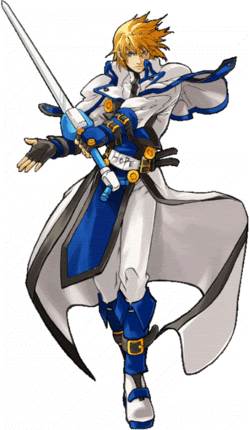
Ragna is kind of an amalgam of various things that I am tired of seeing in anime: swooshy-spiky hair of a color that doesn't really exist (there's gray, there's platinum blonde and then there's sterling silver) coupled with a twenty-third century samurai getup, with additional belt buckles for good measure. When I saw the animated opening to the game as Ragna displayed his Suiseiseki eyes to music that could well be featured in a Rozen Maiden spin-off, I just wanted to think "No, this isn't serious, the eyes are just a parody by the designers, who are of course self-aware of how wall-punchingly generic this guy is", but no, the opening continues, Ragna gets into a dramatic sword fight with Jin Kisaragi (read: Ky plus Ice), and the drama unfolds. That's Ragna for you: a Sol Badguy tweaked for modern sensibilities.

Noel Vermillion sports the world's shortest tie

A side-effect of trying to cater endlessly to the contemporary anime crowd is the attempt to cram way too many things into one design. I can only imagine that Noel is the result of Mori and Katou making a bet on who could come up with a character who featured as many fetish evokers as possible. Her infuriatingly useless ribbons and Apple-designed handguns are one thing; her detached sleeves, bare back and absolute territory are another. (Even sadder is the story of Litchi, a vaguely oriental chick and also the vehicle for more boobs.) BlazBlue's character designers enjoy the technology to reproduce all their zippers and straps in-game with some degree of fidelity, and this doesn't seem have done any good for their judgment of when a design is way too goddamn busy. Echoing on my post regarding the character designs of Rival Schools, I'd like to put these guys in the PS1 era and see what they did with themselves.

I guess the amateurish quality of the art is not doing them any favors either. Character portraits for BlazBlue: Continuum Shift are at least a step up in this regard, with the fighters in more interesting and dynamic poses.

You know, the Guilty Gear games also had some pretty crazy character designs, but they existed in this magical midnight metal carnival sort of atmosphere that characters like I-No embodied so well. The cast of BlazBlue is given a bland synthpop world in which they can just exist while looking pretty and lending themselves to endless badly-drawn fan art. It's not even elegant, it's just... boring, and you know people will lap it up but that will not make it any less boring.

Thanks to Creative Uncut for images.

Wednesday, May 5, 2010

And yet it floats.

Sol Ciel, from Ar tonelico: Melody of Elemia [PS2].

I like floating islands; they're nice and romantic for the most part. If the JRPG is all about high-flying adventure with a rag-tag bunch of loveable cartoons, I can't think of a whole lot of better settings. It's unfortunate, then, that it's so commonly wasted.

Logic tells us that whoever or whatever takes residence on a piece of land that happens to be drifting in the sky has a powerful reason. Either they want to keep everyone else out or desperately want to keep something in. The first option doesn't appeal to me much; "lost tribes" in JRPG's often consist of hermetic, three hundred-year old douchebags in robes who hide the secret to the world's salvation but won't share it with you, because they keep their scepters rammed up their sphincters when they're not using them.

On the other hand, the idea of travelling to some forgotten prison or mausoleum that sits solemn in the upper stratosphere is worthy of pants-creaming. Scenario: You have to retrieve the sacred heirloom of the ancient royal family, who, as undead ghouls, riot within their stately palace-tomb. Another: You have to put down an unfathomable evil, shackled within a God-forsaken fortress and magically lifted to the skies so no foolhardy adventurer would ever try. Imagine the dread.

But for the most part, floating islands seem tacked-on, like afterthoughts. It's like the scenario writer and the concept artist just finished designing all the endless deserts and twinkling crystal castles and sleepy villages, but now they feel the world they've concieved isn't fantasy enough. Okay, make it float!

Eden, from Atelier Iris II: The Azoth of Destiny [PS2].

I guess all these people went to sleep one night, woke up, looked around, and thought "Oh, we're sky people now I guess that's nice".

Maybe I wouldn't be so displeased with this trend if a little originality was injected into the process. Most floating islands float due to a.) a reason that is not immediately obvious but certainly magical, or b.) a reason that is immediately obvious and certainly magical. (Read: giant chunks of crystal sticking out of its underside. I've had it with crystals.)

Perhaps they need to stop being so utopian and start being a little menacing. What about applying the island-turtle concept? The difference would be that, while the unassuming party may not be aware that they've set up camp on a gargantuan sea-monster's back, the denizens of the sky would have to be fully aware that they're riding on a gentle gas giant, wrapped in clouds and thin air. Whoever is willing to live somewhere like that is cool with me.

Thanks to Creative Uncut for pictures.

Monday, May 3, 2010

Ryuusei KIIIIIICK!!


I've always been partial to many of Capcom's in-house artists for many different reasons. A big reason is their healthy emphasis on functionality.

Given how Capcom invented the modern fighter, I imagine that many of their founding character designers must have sat down and looked at this new breed of video game and realized that characters had to be explosively appealing. There's a flimsy vestige of a storyline and a few win/lose quotes, but most if not all 'character development' is going to take place on a two-dimensional battlefield, with fluidly-animated sprites to answer any questions. Not the sillier questions like "Why is he fighting?", which would only spring forth from someone with a well-cemented interest in the game, but more immediate questions like "What does this guy do? Is he awesome?"


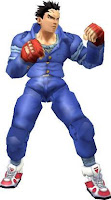
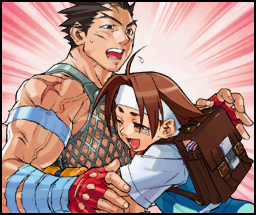
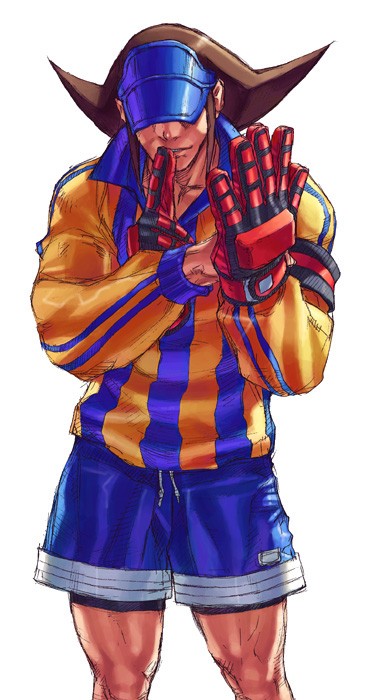
Edayan is in the high tier of Capcom artists, and has contributed to the Street Fighter series countless times. He was also responsible for designing the cast of the sadly forgotten tag-team fighter Rival Schools: United By Fate, a game about dueling high school students where every other character profile includes the term "hot-blooded". It looks, plays and inspires like a passionately-drawn shounen manga does.

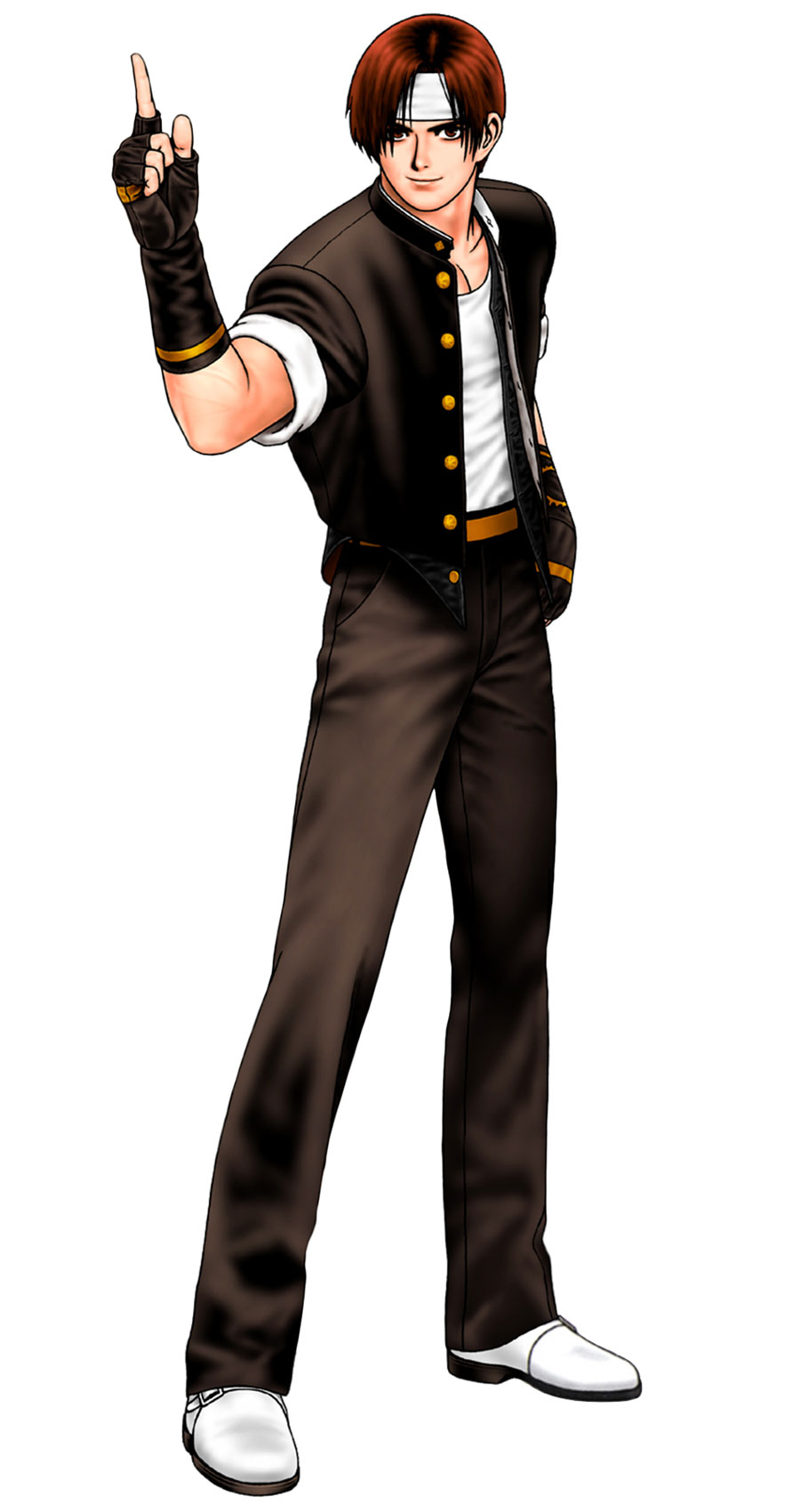
Batsu Ichimonji, P.E. enthusiast and protagonist of the two-game series, exudes the raw, youthful, organic drive that The King of Fighters' sleeker Kyo Kusanagi, who also started off as a uniformed schoolboy, doesn't really capture. If he calls out the names of his attacks, which are things like "Justice Kick", and suddenly scarlet flames envelop his leg as he dropkicks you into the Moon, you will understand that this is what Batsu does. Even though Rival Schools for the PS1 was a bit of a graphical mess (moreso for some characters than others), his defining features, the way in which every part of his outfit, appearance and personal style cooperate to form a coherent portrait, shine through the limited technology.


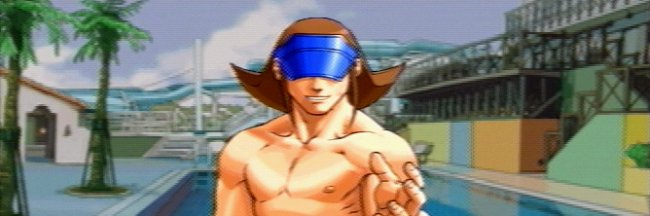
Long before Persona 3 capitalized on Westerners' fervent desire to play as a Japanese high school student, Rival Schools included a day-by-day, life-simulation side-game where you got to know the characters better. [It was left out of the NA release.] This was the kind of thing that senior artists like Akiman and CRMK perhaps didn't anticipate when Street Fighter II was still in the works, but instead of promoting looser design, Rival Schools continues to tell the majority of its story with pictures. The exclamation mark-laden dialogue, full of earnest promises and friends cheering friends on, is almost an accessory to the many visual clues that, for example, visiting the characters at the pool or the beach would provide.

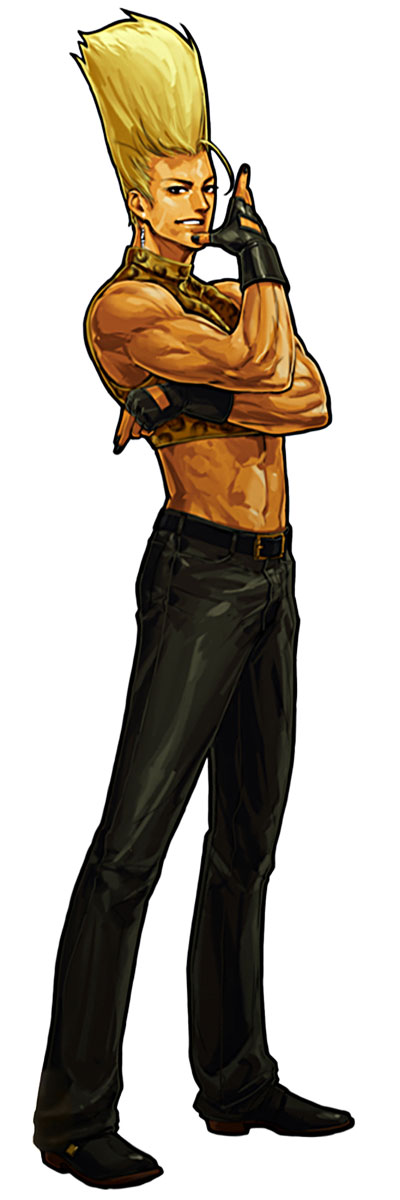
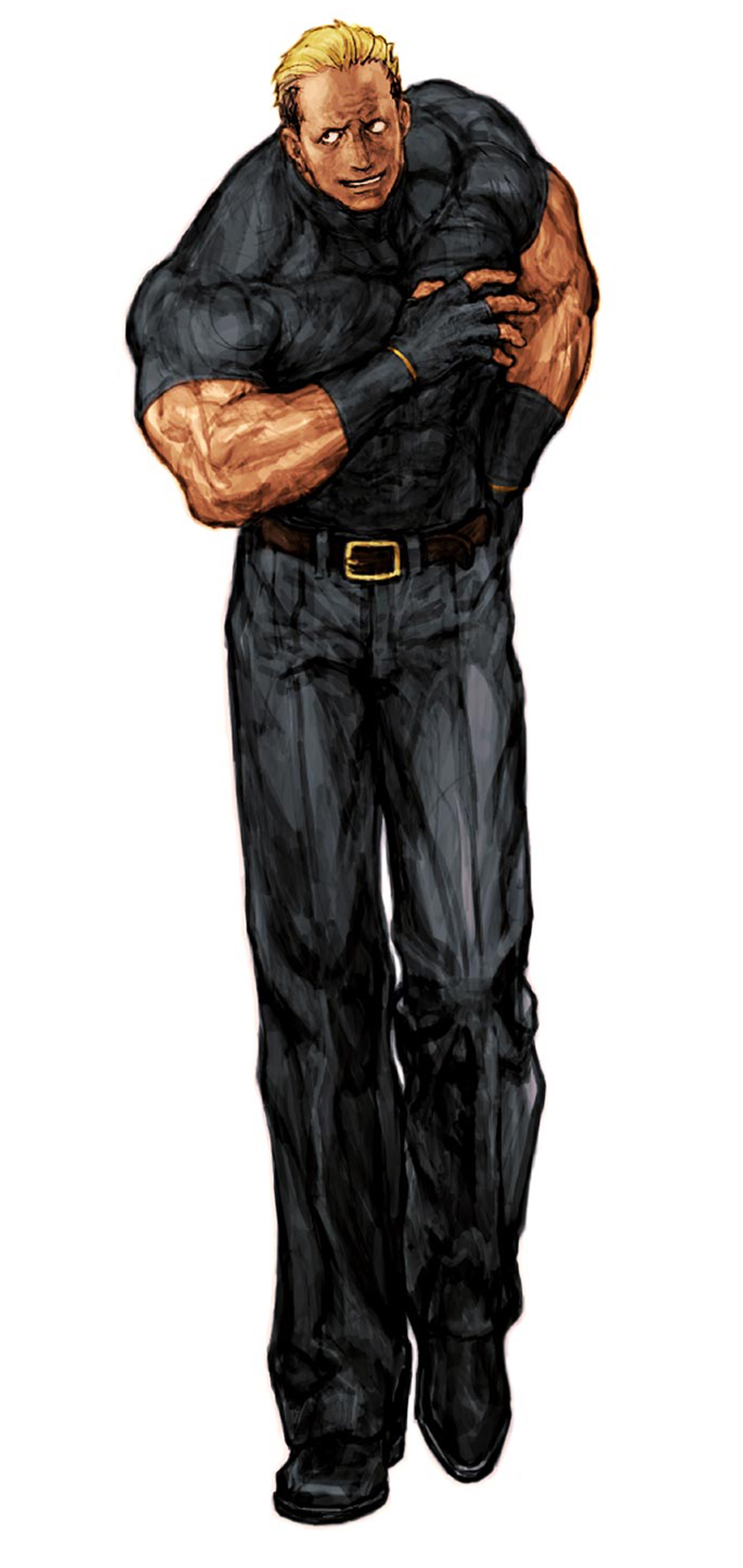
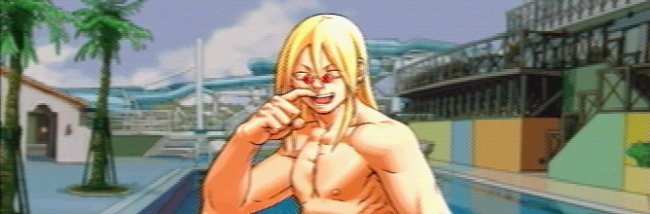
Roberto Miura plays soccer. We know that much from his outfit, and it makes sense when he lobs soccer balls at opponents in battle. The fact that he wears his face-covering visor even to the school pool adds another layer of teasing interest to him; are we ever going to see his eyes? Is he like one of those characters from some TV shows that is never shown from the neck up? The fact that Edge, a purple-clad punk who looks like the lovechild of Benimaru Nikaido and Ryuji Yamazaki, lets his unicorn-hair down in the pool says just about as much on him. Why does Gan, whose bulging muscles can barely be contained by an XXL uniform, wear a full bathing suit? What the crap is he afraid of?

When the studio behind Street Fighter II decided to invite a cast of warriors from around the world into the ring, this concept of characters wearing their nationalities, hobbies and personalities on their sleeves must have weighed heavy on the designers' minds. It's a philosophy that was carried on marvelously to Rival Schools, where Justice High School (for full effect, say that out loud and say it intensely) is alive with little everyday scenes. You can imagine spectacular martial arts showdowns taking place over lunch, in the showers, during the last inning of a baseball game. This is the kind of memorable design that I greatly respect most Capcom fighters for; it's coherent, unified and masterfully executed, and it's more than I can say for many contemporary games in the genre. Maybe that makes the characters cartoons--it almost certainly makes the whole game a cartoon--and I personally love that.


Thanks to The Fighters Generation and Creative Uncut for images.

Let's dance, boys.

Bayonetta
Developer: Team Little Angels [Platinum Games]
Publisher: SEGA
Genre: Action
Platform: XBox 360, PlayStation 3

Rating: 5 / 5 [PURE PLATINUM]

Bayonetta is a game of ecstatic excess. Pumping bullets from heel-mounted, lilac handguns at colossal angels with exquisite rococo-style carvings while standing on a rocketing missile, then finishing the battle by invoking the hellhound Gomorrah to drag the enemy down to Hell--piecemeal--is what it's about. While other, extremely well-established franchises are taking a look at their basic mechanics and trimming the fat (to mixed responses), Bayonetta, a new IP from the indomitable imagination of Hideki Kamiya, makes sure to establish a solid base (a fluid, intensely satisfying battle system) and build a cathedral-crystal-palace-coliseum-department store on top.

I don't really know what Kamiya's intentions were with the story, which includes time travel and the world's equilibrium being shattered. Perhaps he was "flinging shit at a wall", as Tim Rogers aptly put it when reviewing Shinji Mikami's brainchild, the venerable God Hand. Back in January, Lisa Foiles argued that the game may be "too serious" to function within the unabashedly campy ambiance that it created, but I disagree. Just like every other aesthetic element in Bayonetta, including Elena Noguerra's sighs-abound rendition of "Fly Me to the Moon" and the uplifting ecclesiastical pieces reserved for boss battles, all the dialogue and exposition can be taken with a grain of salt or with utmost gravitas, if that's your kind of thing.


Bayonetta follows the development of the titular [hehe, tits] protagonist, as sealed memories return and her origin, purpose and the truth about the "Eyes of the World" are unveiled. In all frankness, Bayonetta is the force that the game's universe orbits around. Secondary characters uncover various facets of her; Enzo and Rodin help us put her power into perspective, Jeanne allows her humanity to blossom (and provides obligatory lesbian overtones), and Cerezita is the catalyst for some incredibly sweet moments. Despite being in a leather-bound, underworld-disco suit, sporting a beehive hairdo with spirit tags woven in, and being roughly seven feet tall, Bayonetta is the most convincing mother figure I've seen in a video game since Miranda in Grandia III. (And that's just about the only nice thing I can say about Grandia III.)

Bayonetta is really a fascinating character; I could talk about her as much, or more, than I could talk about her game. Video games have passed down a number of endearing traditions when it comes to sexualizing women; Japan is fond of innocence interrupted (via peeping tom in the hot springs or gratuitous panty-shots), while America has given us serious strippers: women who are, in theory, held to the same standards as men, but lounge around in chainmail brassieres and curvaceous space suits. (I am reminded of God of War, when the Oracle conveys very serious information to Kratos... while topless.) Bayonetta takes a third option, giving you her sexuality on a silver platter. Through her butterfly double-jumping and skyscraper-throwing, Bayonetta reclaims what the Boss [Metal Gear Solid 3] couldn't, and what Gears of War 3's upcoming female character probably won't, either: the notion that women don't have to sacrifice their femininity to be competent.

And this is why, while some girl gamerz were huffing and puffing over Bayonetta's polished ass being plastered all over their favorite video game websites, the game is really the ultimate kiss-and-bitchslap to Eastern and Western nerd culture. Bayonetta's extraneous proportions already place her outside the realm of Standard Sexy. (This hasn't stopped Playboy from a--probably NSFW--misguided attempt at capitalizing on the character.) That doesn't mean she's not intimidating. She will provoke you whether you want her to or not. She cannot be corrupted like a prepubescent anime girl can, nor is she trying too hard, like the rough-and-tumble tomboy who is ultimately bested by the male protagonist.

Bayonetta is not only an incredibly entertaining game, packed with so much love and attention to detail that eventually you start wondering if every single thing is a reference. It's also a playful, cheeky critique of the portrayal of females in video games. Best of all, it doesn't do this by getting on a high horse and preaching to sexually frustrated teenagers; it revels in the conventions established by the fanbase, and gives them exactly what they want--but remains out of reach. Bayonetta is untouchable; her raw power, ability to sidestep logic whenever convenient, and full awareness (and enjoyment) of her sexuality are what make her one of a kind.

Maybe this is more an appreciative article on Bayonetta the character and what she says about video game females. But my point is: get the game. You'll have tons of fun with the rewarding mechanics, which have naturally evolved from Devil May Cry, and you'll almost certainly laugh out loud right after your jaw drops. And I played the PS3 version! I don't think I can possibly deliver any higher praise than that.


(Okay, how's this? Best game I've played this generation.)

On the topic of Platonic Love

While on vacation in Barbados, one of the many things I decided to tackle head on was that dreaded DS game, Kingdom Hearts: 358/2 days (I still have no idea what this means and please do not attempt to explain it to me.) Fanbase of Kingdom Hearts aside (also see: throwing it into a deep, dark pit where thirteen year old girls can writhe in their throes of bishonen ecstasy until they grow up and clamber out the sides) I am actually rather fond of the game series. It was a massive mixture of Disney and Square Enix Nostalgia; People who didn't play games picked it up for the princesses (as was the case with my friend Sarah) and people who did play games picked it up because apparently Cloud mugged Vincent and stole his clothes before hitting the road on a massive hitchhiking spree to Athens.

Okay, let's bring a little bit of context into this. Let's get this out there: I missed every generation of consoles before about 2002. My heart had always been in games, yes, but they were primarily this ephemeral thing that my dad brought home with him. RTSs like Red Alert and Empire Earth on the computer, a peek at an SNES here and there; which I honestly don't remember much of as the SNES era began on the date of my birth and ended around the time I was six, and most of this time was spent on the computer instead. I don't have many of the memories that gamers only slightly older than me do, or the ones who had a playstation instead of an N64. My first Final Fantasy was X-2, and I had no idea what was going on but I still had a great time playing it. Therefore, most of my late teens geek life has revolved around obtaining these titles that I've missed, filling in my library, playing them, and generally pretending that I knew what it was like when these things came out.

Therefore, when I first played Kingdom Hearts, I wasn't driven by Disney, nor was I really aware of Final Fantasy. They were both non-entities in my life as I was past the point of actively viewing Disney films (although I had experienced close to all of them. Except Tarzan.) And, well, my PS2 had finally started working and I had a grand total of three games for it. (This probably explains my love for Star Ocean 3 as well -- it was the first game that actually worked on my poor old PS2.)

This was a magical little gem of a game. The protagonists were fourteen years old, at best. There was your goofy looking kid, his literally goofy sidekicks, the mysterious prettyboy/rival, and the token princess chick. It was all about light and darkness and tried to be metaphorical and deep -- and was rather trite, in hindsight, if you take it at face value. There is no metagame to Kingdom Hearts. It was a story about nothing more than innocence. Unlike a lot of media at the time, no aspects of the real 'loss' of innocence were involved other than in the most base of terms. There was good, and there was the evil inside of everyone, and a mysterious force of destiny, and that was it. The ending was the epitome of bittersweet and I think it was the first ending of a game I actually ever cried at. (Also was probably one of the first games I beat once I actually got into 'real' gaming. I am setting aside all gameboy and N64 games, because, well, I 
always completed Pokemon and in Ocarina of Time I was too scared to do anything so I just threw chickens around for days on end.)

The second game came out in my first year of highschool, probably the waning year of my rabid frothing fangirl-ism. I looked forward to it because it was probably one of my earlier game sequels that I was actually there for, and, well, it came out on a day that I had off, so I just took it to the basement and played the hell out of the damn thing. It was everything I wanted to be; it coincided perfectly with my own adolescent sense of heightened drama and coolness and sparkles and did I mention drama? The characters were sufficiently pretty, the lines were clean and simple, and I really think it's the only thing I have liked from Nomura since he became lead designer. Well, the sketchy things, at least, and the watercolours or more pastel-y illustrations. They fit the mood.

The first game was an expression in innocence with very little parts 'coming of age' story. It's just a kid trying to get home. Oh, and save his friends along the way. Maybe everybody around him seems to be growing up too fast?

In the second game, we see that the protagonist has jumped ahead two/three years in age without ever really 'growing up', so we've got this weird kid who's not really naive, but I hesitate to use the word innocent. He's got a lot of responsibility on his shoulders, and he knows it. There is a world to save, they're the only ones that can do it, and it's silly and cute and wonderful. But still all he really wants to do is go home. Oh, and save the other friend this time. It's more of a coming of age story this time, except it's still really subtle and not-so-much there; the character's really skipped that breaking-into-teenager part of his life and really the plot is more concerned with questions of What is our existence, why are we here, what's our purpose, WHO DOES ORGANIZATION 13 WORK FOR, Is there really a darkness in everyone's hearts that can't be extinguished--

And ultimately, can we ever go home?

Light and Darkness and yadda yadda yadda aside, the game answers all of these questions in a highly cliched manner. They're silly and childish, and they handle a lot of older characters with the traditional Squeenix 
drama, but therein lies the point. The whole second game is about that sense of childhood that we remember, that nostalgia just out of reach, that we're trying to get to and keep with us and we know that we're older and we can't go back but it was nice anyway. Sora's always looking for his old life back, even though the people around him have changed so much that they're really beyond the point of ever really being the way they were. He breaks down in tears at his friend's feet because it's another sign of things finally being alright again. There's a world to save, there are people to defeat, destinies to uncover -- but he's got that little bit of home back. Axel, in all ways a gigantic bishonen character, longs for things to be back the way they were -- a simpler time, or so he thinks, where all of them can just be friends and nothing can go wrong. But it does. And he knows for a fact that they're older. So he dies a death full of melodrama and teen angst. I still bawled.

And in the end, through faith, they all go home. The golden trio get to their island, the nobodies find peace in death, and maybe everybody really can meet again in the next life.

It's a story about hope.

Now, you know what ruins it for me? The fangirls. I know, I was one of them once, pairing up anything hot that moved. But this condition has lasted long beyond the 14-year-old-girl phase. Some people never get rid of it, I guess. With the introduction of Organization 13, they've got a whole treasure trove of slightly feminine boys to pick from. (I have to say that I have a slight thing for Luxord's facial hair. Mmm, neatly trimmed goatees.)

Because of all this innocence in the game -- that being the entire 
point -- it just comes off as inherently wrong to me. It's like trying to sexualize a Disney movie. You could try to do it, and it works well in theory, but in practice the whole action seems inherently like wish fulfillment. The game is about Friendship. There was no sex going on behind the scenes here, or at least, it's a non-entity, a seeming missing element that was nonetheless inherent to the plot. If one tries to take it as romantic love, they're getting it all wrong. You could call it friendship, in loosest terms, but I like to see it as the love and devotion shared between the closest of friends, the ones who you would move mountains for and end up in jail with. The hope that they're still alright, the quasi-family status they attain, the vague sense of comfort.

Sexualization makes it all wrong. It's about longing for the past, and the acceptance of things that have changed, but not for the worse. About the love between friends, about hope, and the generalized good and evil and grey area inbetween where kids ask 
who am I?

The island of Barbados resembles the one from the game in a very loose sense. I laid on my back and let myself be pulled out by the tide; I got cut by coral, I got salt in my eyes, I got burned by the sun, but it was beautifully visceral and I was utterly at peace. Reminded of days lost, days found, lazy days I didn't know what to do with, and active ones that I let fly by. And again, that beautiful bittersweet that comes from an ending where you got what you wanted, but at what cost? It's not a poginant or wonderful game for the DS, but it carries the feeling along with it.

I beat it and got teary eyed.